● Governance COSCO SHIPPING Development recognizes climate change response as a key material topic for its sustainability management. The Company has established a Carbon Peaking Steering Group and corresponding working groups to guide, coordinate, and advance its carbon peaking efforts. Cross-functional coordination is carried out among various departments and subsidiaries, including the Department of Strategic Development, the Department of Industrial Investment, Shanghai Universal, and the Division of Shipping Leasing. Shanghai Universal has implemented the Regulations on Energy Conservation and Emissions Reduction Management, under which emissions reduction responsibilities are integrated as binding criteria into the performance evaluations of department heads. Based on the Company's overall annual energy conservation and emissions reduction (ECER) targets, specific indicators are allocated to individual departments and incorporated into their respective responsibility statements. Performance is evaluated in accordance with the Energy Conservation and Emissions Reduction Performance Scoring Sheet. If a major environmental incident results in significant social impact, or a serious violation of ECER requirements leads to adverse consequences, all performance-based bonuses may be forfeited. ● Strategy COSCO SHIPPING Development keeps track of domestic and international regulatory trends, adapts to evolving environmental standards in the container manufacturing and leasing industry, and stays responsive to emerging customer needs. With deep insights into the unique characteristics of each business segment, the Company focuses on five strategic priorities: material innovation and efficient use, energy decarbonization and system efficiency optimization, technological innovation and process improvement, resource conservation and recycling, and reduction of product carbon footprint. In 2023, the Company introduced a comprehensive roadmap for its low-carbon transition. The roadmap outlines four strategic pillars and eight implementation pathways, with clearly defined tasks for each business segment. Each segment thereby develops actionable plans, setting measurable targets, and ensuring clear lines of individual accountability. For the container manufacturing segment, the long-term goal is to achieve carbon neutrality by 2050. 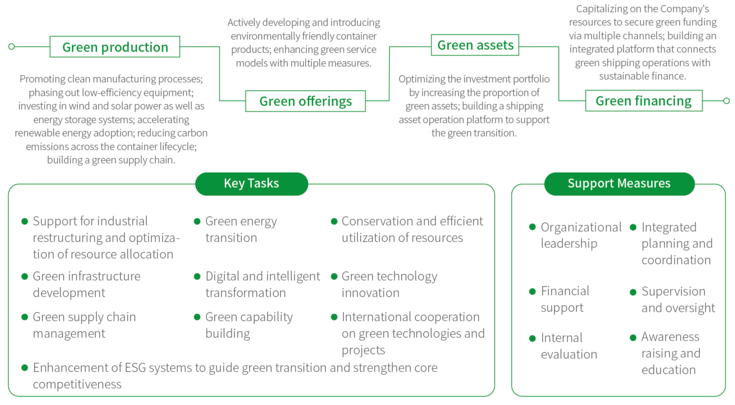
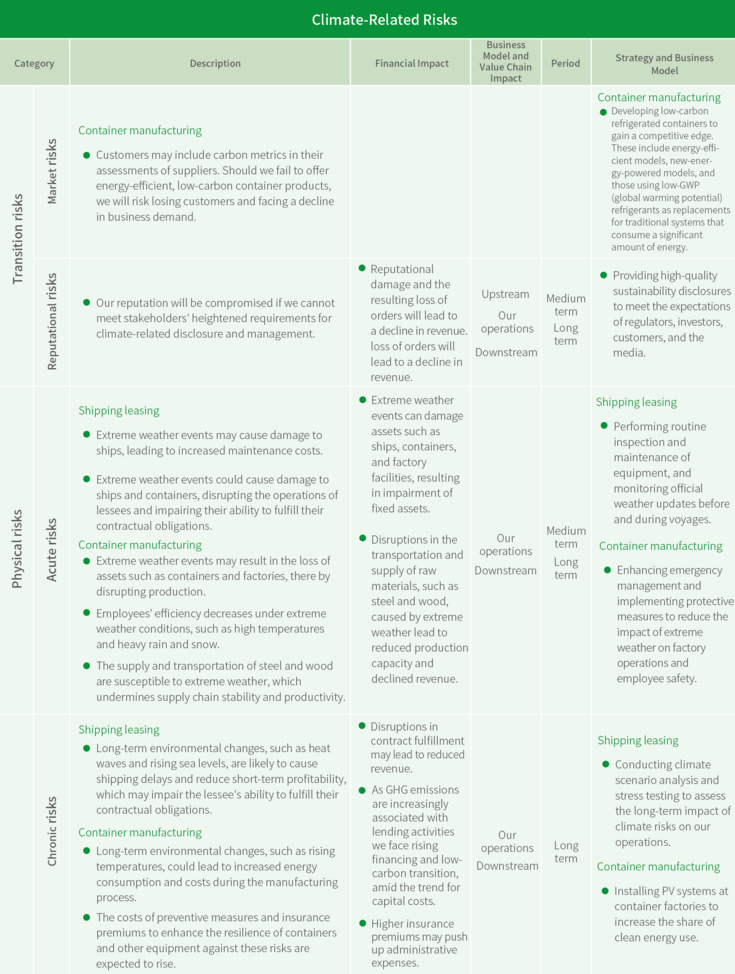
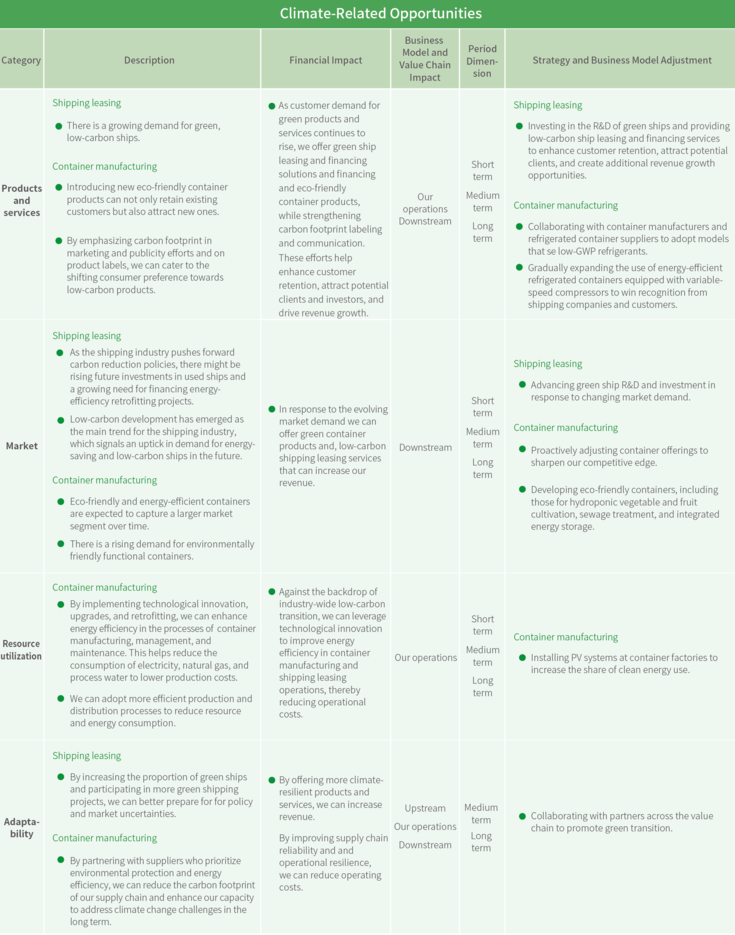
COSCO SHIPPING Development adopts internationally recognized climate scenario analysis methodologies to conduct a systematic assessment of climate-related risks and opportunities. The analysis draws on several models, including the International Energy Agency (IEA)'s "Net Zero Emissions by 2050 Scenario (NZE 2050)" and "Stated Policies Scenario (STEPS)," as well as the Intergovernmental Panel on Climate Change (IPCC)'s "Representative Concentration Pathways (RCPs)". 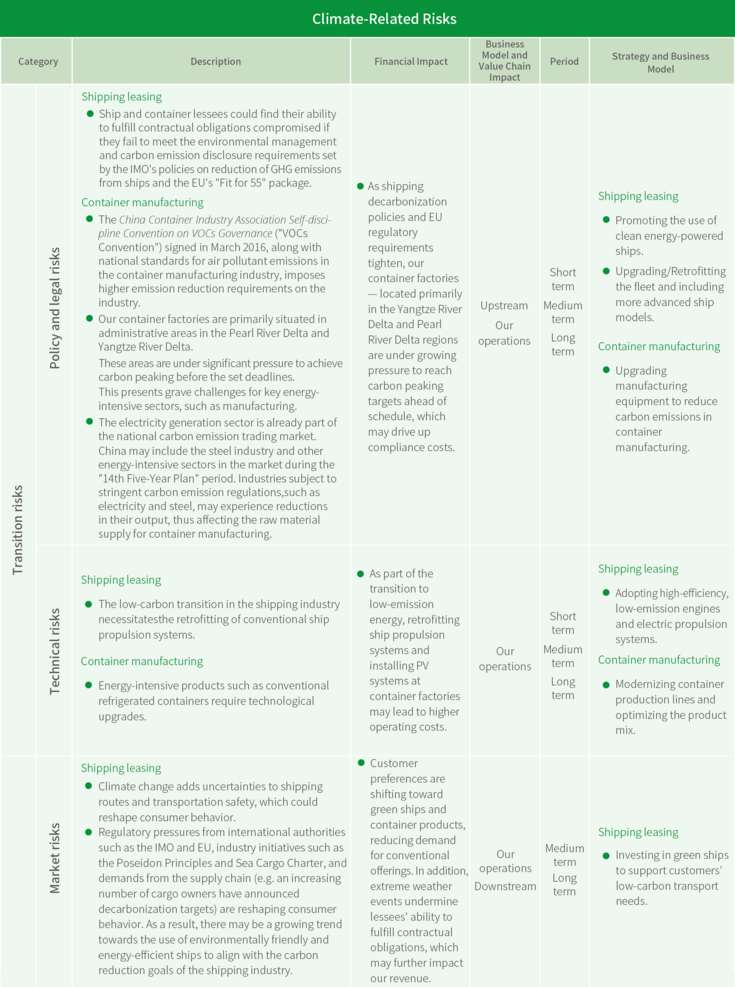
(1)Green Container Manufacturing Shanghai Universal integrates environmental management goals into its broader corporate strategy, ensuring that environmental considerations are embedded in strategic decision-making. This helps strengthen the alignment between business operations and sustainability principles. The company formulates practical environmental management plans, with targeted actions across key areas such as resource efficiency, waste management, and pollution control. In addition, annual safety and environmental responsibility statements are signed across all levels of the organization, clarifying roles and performance targets. A robust monitoring and evaluation mechanism is also in place to ensure effective implementation and ongoing improvement of environmental management efforts. To promote the low-carbon transition of the entire container supply chain, Shanghai Universal launched the world's first CFP & EPD platform for containers on October 8, 2023. The platform uses data graphs to analyze how raw material production processes and logistics transport modes impact the environment. It supports green procurement by encouraging the adoption of eco-friendly materials such as corner castings made from recycled steel, bamboo-wood composite flooring, and reusable containers for water-based paints, thus helping reduce carbon emissions at the source. The platform also conducts digital analysis of production inputs to dynamically evaluate operational efficiency and optimize workflows and process design. These efforts drive technological upgrades and contribute to further reductions in CO₂ emissions. By the end of 2024, the platform had connected 95 enterprises across the industry chain. In collaboration with third-party institutions such as the CCS, it had issued 15 CFP-certified and 25 EPD-certified products, contributing to low-carbon development across the industry chain. At the Intermodal Asia 2024, Shanghai Universal introduced the first low-carbon container label, which received wide recognition from customers. More than 36,000 containers bearing the label have since been transported across global markets. Shanghai Universal also launched a series of ECER training programs to ensure that relevant managers and equipment operators are well-versed in relevant knowledge and operational practices. The company continues to strengthen comprehensive talent training in ECER, taking a structured approach to building a skilled and specialized workforce. Shanghai Universal and its affiliated container factories encourage employee participation in environmental management and maintain close communication with government agencies, industry organizations, and third-party partners to advance joint environmental initiatives. In 2024, the company held ECER campaigns, such as "Energy Awareness Week" and "Low-Carbon Day" to promote relevant national guidelines, policies, laws, regulations, industry standards, and scientific knowledge, while enhancing employee awareness of ECER. In 2024, Shanghai Universal conducted 22 ECER training sessions, recording 8,045 participations in total. (2)Green Shipping COSCO SHIPPING Development is committed to becoming a world-class shipping and finance service operator with COSCO SHIPPING characteristics. Upholding industry-finance integration and finance as an enabler of industry growth, the Company is strengthening its shipping leasing portfolio by investing in newer, greener vessels with advanced environmental performance and high operational efficiency. This asset-centric approach underpins its transformation into a value-oriented investor and innovative service provider in industry-finance integration. In response to the global energy transition, the Company is actively capturing opportunities in clean technology innovation. By increasing investment in this area, we strengthen our resource distribution across the clean energy value chain, driving low-carbon transition in the shipping industry and enhancing sustainability. 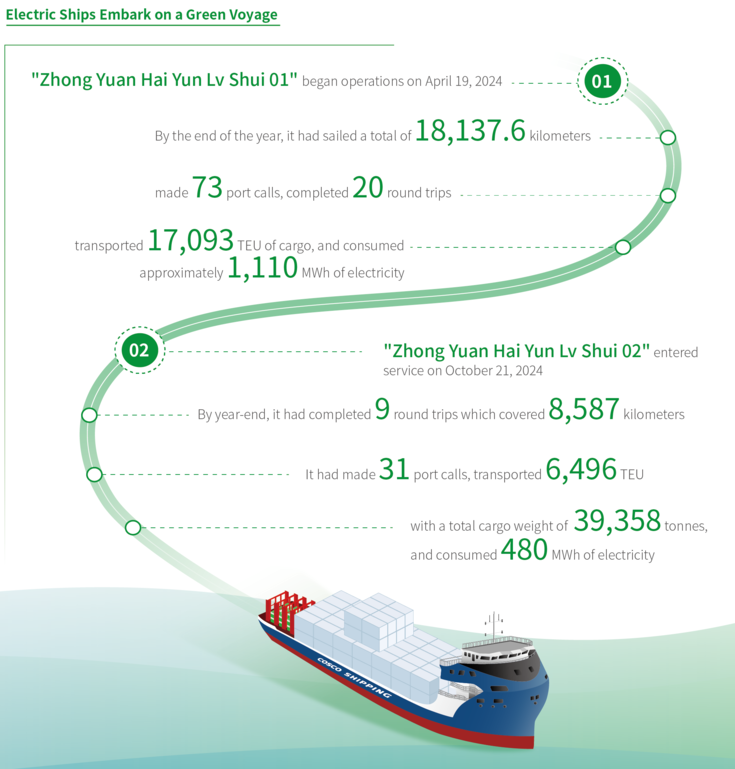
(3)Green Financing In June 2024, COSCO SHIPPING Development released a mid-term revision to its 14th Five-Year Plan, setting clear goals and measures for medium- to long-term capital deployment. COSCO SHIPPING Development assessed capital requirements and prepared budgets for key initiatives and major engineering projects in its Green Transition Plan, ensuring sufficient funding to support the transition. The Company also introduced internal policies to manage the use of dedicated green transition funds and began exploring diversified investment portfolios to support green innovation, drive technology R&D, and improve capital efficiency. In 2024, the Company secured more than RMB 3 billion in green loans. Its subsidiary, Shanghai Universal, invested over RMB 16.57 million in green efforts. (4)Green Workplace The Company champions environmentally responsible practices in the workplace by offering training and awareness programs that enhance employees' understanding of environmental protection. At the same time, employees are encouraged to incorporate green and low-carbon principles into their daily routines, contributing to sustainability through practical actions. ● Management of Impacts, Risks, and Opportunities 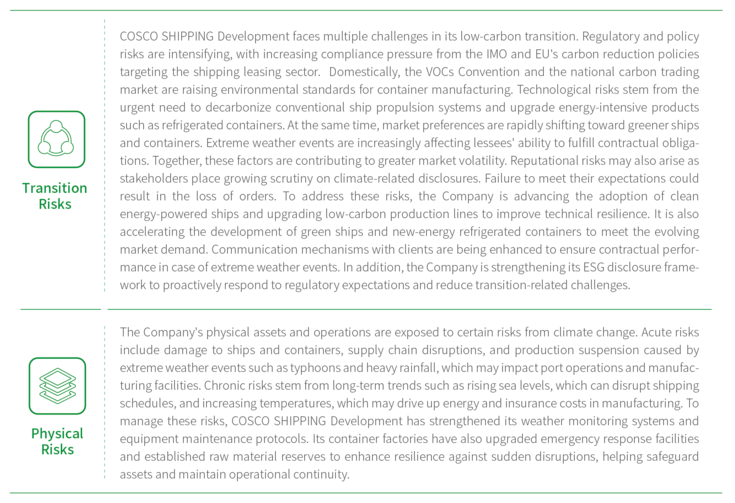
● Indicators and Targets COSCO SHIPPING Development's GHG emissions are primarily driven by CO₂ released from container manufacturing and transportation activities. Following a comprehensive assessment of emission trends and business plans for the container sector, the Company has set the following intensity-based reduction targets: a 19% decrease in CO₂ emissions per RMB 10,000 of revenue by 2025, and a 34% reduction by 2030, both from a 2019 baseline. 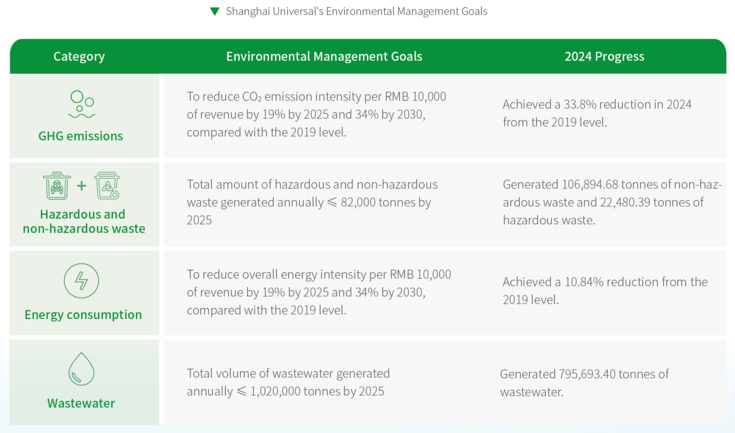
|